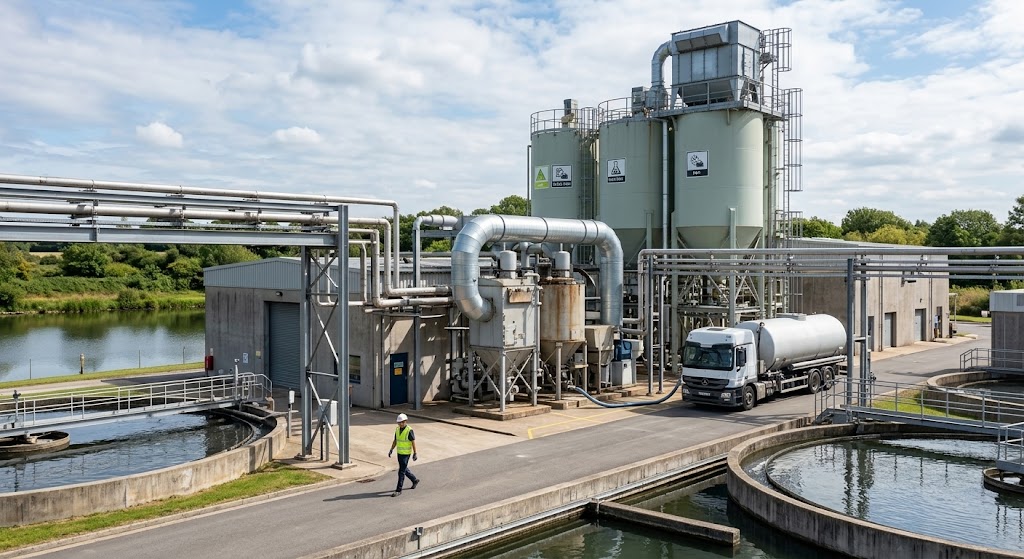
Storage silos are typically filled pneumatically by delivery trucks. As the silo is a closed system, there needs to be a venting mechanism for the air that acts as the carrier for the powder. There are two major types of dust collectors used in silos in the municipal water treatment sector, where the powders handled are typically lime, soda ash and PAC. The following is provided as a guide to help decide which type to use.
When selecting a dust collector (often called a "bin vent") for a powder storage silo, the choice usually comes down to how the filter bags are cleaned. While both styles use fabric bags to trap powder, they differ significantly in their maintenance needs, operational efficiency, and air requirements.
Quick Comparison Table
|
Feature |
Pulse Jet (Jet-Pulse) |
Bag Style (Shaker/Static) |
|
Cleaning Method |
High-pressure compressed air pulse |
Mechanical shaking or gravity/manual |
|
Silo Operation |
Continuous (cleans while filling) |
Intermittent (cleans after filling) |
|
Maintenance |
Low (no moving mechanical parts) |
Moderate (requires motor or manual labor) |
|
Air Supply |
Requires clean, dry compressed air |
No compressed air required |
|
Filter Life |
Shorter (aggressive cleaning) |
Longer (gentle cleaning) |
1. Pulse Jet Dust Collectors
Pulse jet systems are the modern industry standard for silos that are filled frequently or via pneumatic conveying (where high air pressure is used to move powder).
- How it Works: A sensor or timer triggers a solenoid valve to release a short "burst" of compressed air down into the filter bags. This creates a shockwave that flexes the bag outward, dislodging the dust cake which then falls back into the silo.
- Key Advantage: Online Cleaning. It can clean the filters while the silo is being filled. This prevents pressure build-up inside the silo, which is a major safety risk (silo over-pressurization can lead to roof failure).
- Requirement: You must have a reliable source of compressed air. If the air is wet or oily, it can clog the bags, creating a "mud" that is impossible to clean.
2. Bag Style (Shaker) Dust Collectors
Traditional "bag style" collectors usually refer to mechanical shaker units. These are more common in smaller operations or where compressed air is unavailable.
- How it Works: These units rely on a mechanical motor or a manual lever to shake the bags and vibrate the dust loose.
- Key Limitation: Offline Cleaning. You generally cannot shake the bags effectively while air is still blowing through them (i.e., during the filling process). If you try to clean them while filling, the upward airflow simply pins the dust back against the fabric.
- Key Advantage: Simplicity. They are "plug and play" since they don't require piping for compressed air. They are also gentler on the filter media, often resulting in bags that last years longer than pulse-jet versions.
Which one should you choose?
- Choose Pulse Jet if: You fill your silos pneumatically (via truck), have high turnover, or need the system to run 24/7 without stopping for cleaning cycles.
- Choose Bag/Shaker if: Your silo is filled slowly (gravity/bucket elevator), you don't have compressed air on-site, or you want a simpler system with lower utility costs.