Where Disinfectant Incidents Actually Start
Receiving-dock and tank-release failure modes for bulk sodium hypochlorite at US water plants
Ethan Brooke, cleanwater1 · May 19, 2026 · v1.1 · For utility safety officers and plant managers
|
FOR PLANT MANAGERS Switching from chlorine gas to bulk 12.5% sodium hypochlorite is a real safety improvement on paper. In practice, the same chlorine-gas release event you switched to avoid can still happen at the receiving dock — bulk NaOCl plus an acid or an incompatible coagulant on the same delivery path produces chlorine gas at the point of mixing. The MGPI Processing event (Atchison KS, 2016) and the Birmingham Water Works event (Shades Mountain WTP, 2019) are the canonical documented cases. Storage and maintenance releases at concentration — like the 7,000-gallon NaOCl release at Vallejo's Fleming Hill WTP in May 2026 — are a second mode. Neither failure mode shows up in EPA's Risk Management Program data, because bulk sodium hypochlorite is not on the RMP list. This note describes both failure modes, what the federal record captures, and what changes when sodium hypochlorite is generated on site at 0.8% concentration instead of trucked in at 12.5%. |
1. The receiving-dock failure mode
The largest documented bulk sodium hypochlorite events at and adjacent to water plants have not been container failures. They have been cross-contamination events: bulk NaOCl contacts an acid or an incompatible coagulant during a delivery or transfer operation, and the resulting reaction off-gasses chlorine at the point of mixing. The plant has done nothing the operator's manual rules out — it has simply colocated bulk NaOCl with the coagulants and acids it also routinely receives.
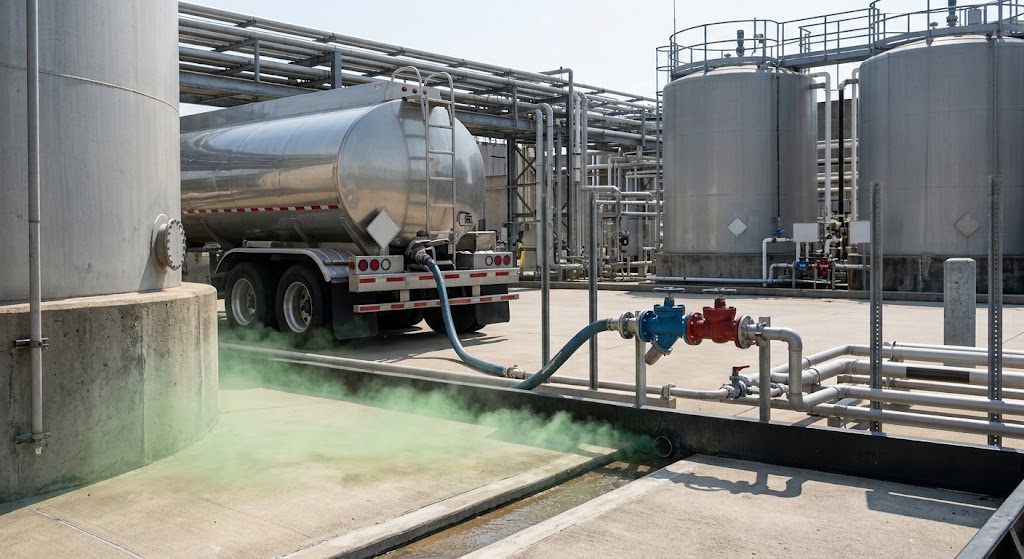
MGPI Processing, Atchison KS — October 21, 2016. A sulfuric-acid delivery truck was inadvertently connected to a bulk sodium hypochlorite fill line. The cross-contamination produced a chlorine-gas plume; shelter-in-place orders were issued, and over 120 employees and members of the public sought medical attention. The CSB issued its final investigation report in January 20181. The facility was a distilled-spirits plant, but the failure mechanism — bulk NaOCl plus an incoming acid on the same loading apron — is the dominant NaOCl hazard at water plants, where ferric sulfate, alum, sulfuric acid, and hydrofluosilicic acid are commonly delivered alongside the disinfectant.
Birmingham Water Works, Shades Mountain WTP — February 27, 2019. Bulk sodium hypochlorite and ferric sulfate were inadvertently combined during a delivery operation. The reaction off-gassed chlorine on site. Approximately 55 people were transported for medical evaluation; US Highway 280, which runs immediately adjacent to the plant, was closed for over two hours2. The event is sometimes externally catalogued as a chlorine release — operationally, the chemicals on the dock were bulk NaOCl and a coagulant.
The pattern is consistent across both events. The hazard does not live in the disinfectant alone; it lives in the colocation of bulk NaOCl with another routinely-delivered plant chemical, on the same dock, sharing the same hose adapters, the same transfer pumps, the same operator attention. The class of event that bulk NaOCl was supposed to retire — a chlorine-gas release — is not retired; it is moved upstream from the chlorine-storage room to the receiving operation.
2. Tank and storage releases at concentration
A second failure mode shows up without cross-mixing — straightforward release of bulk NaOCl from storage or transfer infrastructure. At 12.5% concentration, the consequences scale with volume.
Fleming Hill WTP, Vallejo CA — May 13–14, 2026. Approximately 7,000 gallons of sodium hypochlorite released from a storage tank during a maintenance event involving secondary containment. The release was contained on site and no injuries were reported3. The favorable outcome was a function of the containment system, not the absence of a release. Comparable events without secondary containment would have produced an off-site release of pH-13 corrosive liquid.
Vallejo is one event in a class. Bulk-NaOCl storage and transfer failures include tank rupture, valve and gasket failures, transfer-hose failures during deliveries, and corrosion-induced releases at the bottom of long-service tanks. Most are handled at the facility level and never enter federal aggregates because the CERCLA reportable-quantity threshold for available chlorine (10 lb in 24 hours) is sometimes not met, or the release is fully contained. These events still consume operator hours, regulatory paperwork, and insurance-premium exposure — the operational reality the federal record does not capture.
3. What the federal record captures — and what it misses
Chlorine gas is on the EPA Risk Management Program list (40 CFR 68). Bulk sodium hypochlorite is not4. The practical effect: a small chlorine-gas release at a plant becomes an RMP accident-history entry, while a 1,000-gallon NaOCl release at the same plant may never enter a federal aggregate. EPA's analyses of the RMP record identify approximately 8 to 9 reportable accidents per year at water-supply and POTW facilities (NAICS 2213), across roughly 1,968 chlorine-using water-sector RMP filers5.
|
Substance |
On EPA RMP list? |
NRC share, 2010–2019 |
|
Chlorine gas (Cl₂) |
Yes — 2,500 lb threshold |
4 % |
|
Bulk sodium hypochlorite (NaOCl, 12.5%) |
No — exempt at use concentrations |
3 % |
|
Other CWA hazardous substances |
— |
93 % |
Sources: EPA RMP applicability guidance for sodium hypochlorite; 87 Fed. Reg. 17,890 (March 28, 2022), Table 3, citing NRC 2010–2019. NRC figures are cross-industry.
In the database that catches both substances at comparable thresholds — the National Response Center — chlorine and sodium hypochlorite produce releases at near-parity (4% vs. 3% of all CWA hazardous-substance discharges). For a chemical not even on the RMP list, that frequency is the load-bearing operational signal.
4. What changes at 0.8% on-site
Both failure modes — receiving-dock cross-contamination and tank-and-transfer releases — scale with the concentration of the sodium hypochlorite on site. The off-gas mass from a cross-mixing event scales linearly with available chlorine content; the severity of a tank release scales with the available-chlorine load in inventory.
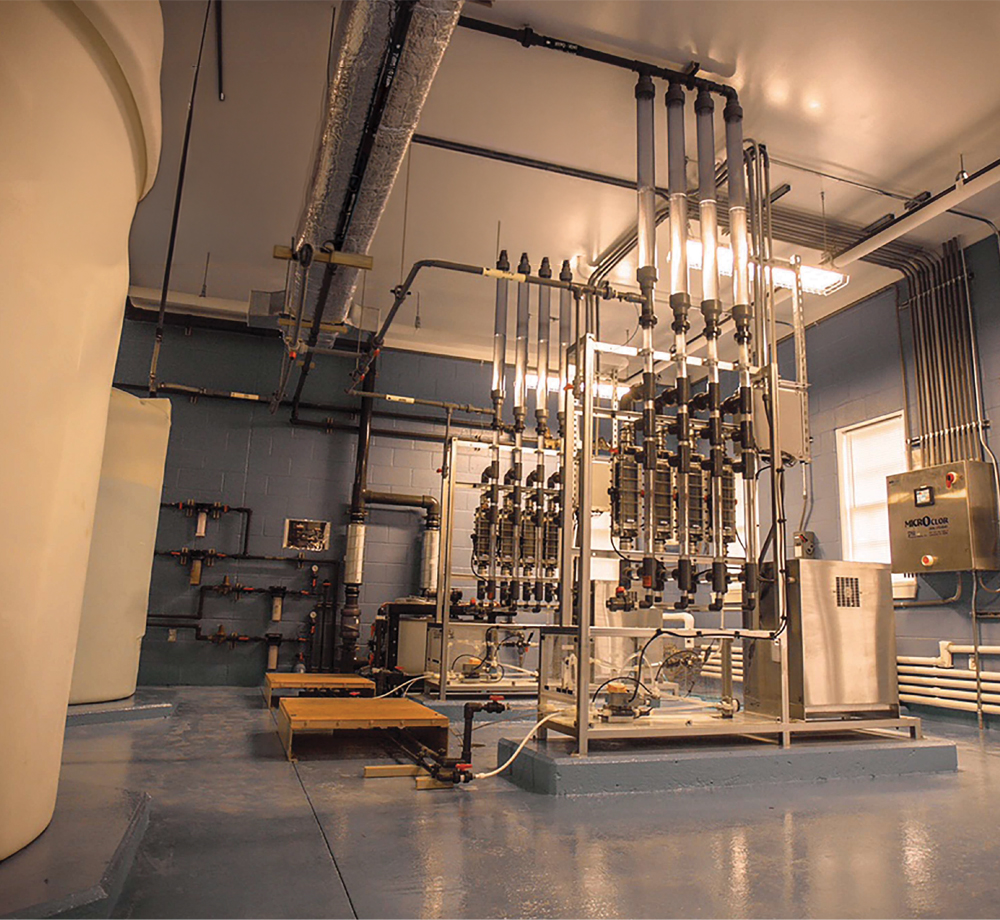
Microclor generates sodium hypochlorite on site at 0.8% concentration from salt and water — approximately one-sixteenth the concentration of trucked-in bulk 12.5%. The upstream chain that produces the receiving-dock and tank-release failure modes does not exist in the on-site-generation configuration:
-
No incoming sodium hypochlorite tanker to mis-connect at the receiving dock. The MGPI failure mode requires an incoming hazardous-chemical delivery; on-site generation removes the delivery.
-
No concentrated NaOCl in bulk storage to cross-contaminate. The Birmingham failure mode requires bulk NaOCl on the delivery apron at the same time as an incompatible coagulant; on-site product is generated, dosed, and consumed at low strength.
-
Tank-release severity scales down by roughly the concentration ratio. A 7,000-gallon Microclor product release is roughly equivalent in available-chlorine content to a 450-gallon bulk-NaOCl release — small enough that the Fleming Hill response would have been routine rather than emergency.
-
No RMP threshold quantities of chlorine gas on site, by construction. The chlorine-gas catastrophic-release class is removed at the chemistry level, not relocated upstream.
Independent utility-side industry research identifies safety as the primary reason utilities convert to on-site generation, ahead of cost and supply-chain considerations. The operational evidence above is consistent with that finding. Switching off chlorine gas is the well-understood half of the safety case; the harder half — switching to a bulk chemical that quietly inherits a comparable failure-mode profile, just shifted upstream — is the question on-site generation of low-strength sodium hypochlorite is built to answer.
By generating low-strength, non-hazardous 0.8% sodium hypochlorite on site from simple salt and water, a plant goes from managing one of its most dangerous operations to one of its safest. No hazardous chemical deliveries to receive. No RMP compliance overhead. No bulk-NaOCl tank inventory to contain. And no co-located coagulant deliveries that can produce a chlorine-gas event at the moment of mis-connection.
References
1. US Chemical Safety and Hazard Investigation Board, Toxic Chemical Release at MGPI Processing, Inc., Atchison, Kansas, October 21, 2016 (final report, January 2018). https://www.csb.gov/mgpi-processing-inc-toxic-chemical-release-/
2. Aggregated public-source reporting on the Birmingham Water Works Shades Mountain WTP chlorine release, February 27, 2019 (AL.com, Birmingham Times, ABC News, NBC News).
3. Aggregated public-source reporting on the Fleming Hill Water Treatment Plant sodium hypochlorite release, Vallejo CA, May 13–14, 2026 (Vallejo Sun, Daily Republic, Times-Herald, SFGATE).
4. US Environmental Protection Agency, Amounts of Chlorine Present in Sodium Hypochlorite (RMP applicability guidance). https://www.epa.gov/rmp/amounts-chlorine-present-sodium-hypochlorite
5. US Environmental Protection Agency, Safer Communities by Chemical Accident Prevention rulemaking docket EPA-HQ-OLEM-2025-0313 (RIA; RMP accident-data analysis). https://www.regulations.gov/docket/EPA-HQ-OLEM-2025-0313
6. Federal Register, Clean Water Act Hazardous Substance Worst-Case Discharge Planning Regulations, 87 Fed. Reg. 17890 (March 28, 2022). https://www.federalregister.gov/documents/2022/03/28/2022-05505